
Office Cleaning vs Commercial Cleaning: Which Do You Need?

Office Cleaning vs Commercial Cleaning: Which Do You Need?
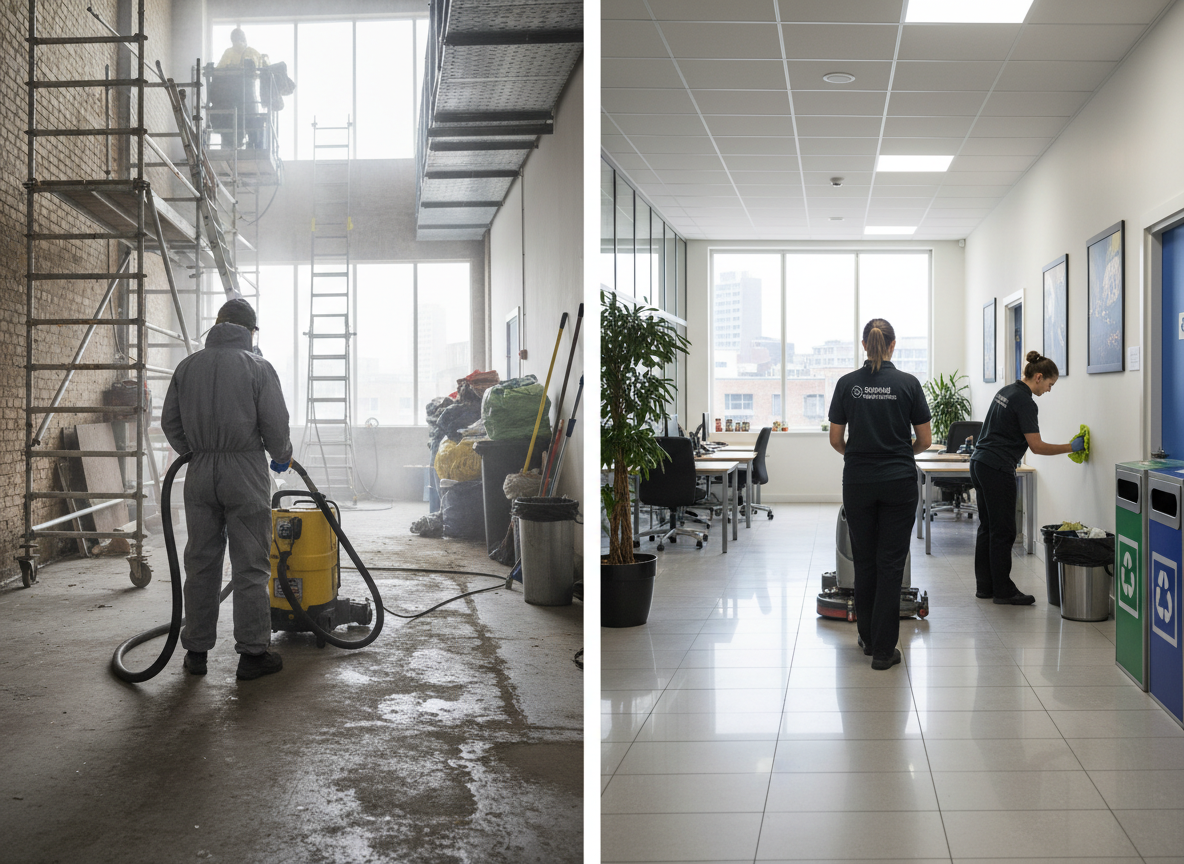
Many businesses use the terms office cleaning and commercial cleaning as if they mean the same thing. They are close, but they are not always identical. Office cleaning usually focuses on desks, meeting rooms, shared kitchens, toilets, entrances, and the daily working environment. Commercial cleaning is broader and can cover offices as well as other business premises with different layouts, traffic patterns, and cleaning needs.
Quick answer: if your site is mainly desk space, meeting rooms, shared kitchens, toilets, and reception areas, office cleaning is often the right fit. If the building includes wider customer areas, mixed-use space, heavier footfall, operational zones, or a broader site layout, commercial cleaning may be the better option. The easiest way to tell is to look at how the building is used each day, not just what it is called.
Plenty of businesses ask for an office cleaning quote when what they really need is broader commercial cleaning. Others ask for commercial cleaning when the site is really a straightforward office environment with regular shared spaces that need keeping on top of.
That confusion is common because both services overlap. Both are business cleaning. Both aim to keep the place clean, presentable, and easier to work in. The difference is usually in the layout, the way the building is used, and the kind of cleaning plan that makes sense for that environment.
If you are looking at office cleaning in Sheffield or trying to work out whether your site needs something broader, this guide breaks it down in plain terms so you can choose the right route.
What is office cleaning?
Office cleaning is usually built around the spaces people expect to find in a typical workplace. That means desks, workstations, meeting rooms, receptions, kitchens, toilets, corridors, break areas, and shared touchpoints that get regular daily use.
The main aim is to keep the working environment clean, presentable, and practical for staff and visitors. It is often routine based. Some offices need daily attention. Others need a few visits each week. Smaller workplaces may only need lighter regular support, while busier offices need a tighter schedule.
The service is usually shaped around predictable use. People arrive, work, hold meetings, use shared facilities, and leave. That kind of pattern makes it easier to build a regular cleaning checklist around the week.
Office cleaning often covers
- Reception and entrance areas
- Desks and workspaces
- Meeting rooms
- Staff kitchens and break areas
- Toilets and washrooms
- Corridors, doors, and shared touchpoints
Office cleaning often suits
- General office buildings
- Shared office suites
- Professional service businesses
- Smaller headquarters or admin sites
- Businesses with client-facing meeting rooms
- Workplaces with regular staff use but limited operational mess
What is commercial cleaning?
Commercial cleaning is the broader term. It can include office cleaning, but it also covers a wider range of business premises and more varied site layouts. Commercial sites may have office space, customer-facing areas, staff facilities, circulation routes, storage sections, entrances, welfare areas, and other mixed-use zones all under one roof.
In other words, office cleaning is often a type of commercial cleaning, but commercial cleaning is not limited to offices.
This matters because the larger or more mixed the site becomes, the less useful it is to think only in terms of desks and office rooms. You may need a plan that deals with wider traffic patterns, bigger public-facing areas, changing use through the day, and more varied cleaning priorities.
That is why businesses with more complex layouts often get better results from a broader commercial cleaning service in Sheffield rather than trying to fit everything under an office-only label.
The simplest way to think about the difference
Office cleaning is usually focused on a standard workplace environment.
Commercial cleaning is usually focused on a wider business environment.
That sounds basic, but it is the clearest way to frame it. Once you look at the building through that lens, the right fit becomes easier to spot.
| Point of comparison | Office cleaning | Commercial cleaning |
|---|---|---|
| Main setting | Office-led workspaces | Broader business premises |
| Typical areas | Desks, meeting rooms, kitchens, toilets, reception | Offices, customer areas, entrances, shared zones, mixed-use spaces |
| Layout style | Usually more predictable | Often more varied |
| Footfall pattern | Mainly staff and visitors | Can include customers, staff, contractors, and higher daily movement |
| Cleaning plan | Often routine and room-based | Often wider and more site-based |
| Best fit | Standard workplaces | Mixed-use or broader commercial sites |
When office cleaning is usually the right choice
If the building is mainly set up for desk-based work and shared staff use, office cleaning is often the right fit. The key sign is that the cleaning priorities are tied to how a normal workplace functions rather than to broader public or operational use.
Your site is mostly desk space and shared facilities
If your main concerns are workstations, kitchens, toilets, meeting rooms, reception areas, and general day-to-day presentation, you are likely looking at office cleaning rather than a wider commercial brief.
You need a regular workplace standard
Many offices do not need large reactive cleans. They need consistent upkeep. The bins need emptying, the shared kitchen needs attention, the toilets need staying on top of, and the office needs to feel clean each working day. That is the kind of routine office cleaning is built around.
Your visitors mainly enter through meeting or reception space
If clients, visitors, or staff mainly see typical office areas rather than public retail zones or mixed-use operational sections, office cleaning is often enough to cover what matters.
When commercial cleaning is usually the better choice
Commercial cleaning tends to make more sense when the site goes beyond a simple office setup. That might be because it includes more footfall, mixed-use space, public areas, or different sections that each need their own attention.
Your building is not purely an office
Some businesses have offices within a much broader site. The office may sit alongside storage areas, customer spaces, welfare sections, circulation routes, or light operational zones. In that case, it often makes more sense to think commercially rather than office-only.
You have wider customer-facing areas
If customers, visitors, or service users regularly move through the building, the cleaning plan often needs to reflect that. Entrances, waiting areas, circulation routes, shared toilets, and other public spaces may matter just as much as the office itself.
You need a site-wide view rather than room-by-room focus
Commercial cleaning often fits businesses that need the whole environment looked at together rather than treated as a few office rooms plus a kitchen and toilets. This is common where businesses have varied zones that all affect presentation and daily standards.
Where the site is clearly more operational or industrial, it may even move beyond general commercial cleaning into services such as factory and warehouse cleaning.
Why the wrong label can lead to the wrong quote
If you describe a mixed-use commercial site as “just office cleaning”, the quote may miss parts of the building that actually need attention. On the other hand, if you ask for broad commercial cleaning when the site is a straightforward office, the brief can become wider than it needs to be.
Neither problem is dramatic, but both can slow things down. The best starting point is to explain how the building is used and what areas matter most. That gives a much clearer picture than the label alone.
A good cleaning plan should fit the real site, not just the term you happen to use first.
Questions to ask before you choose
If you are not sure which route fits, start with these questions.
Ask yourself this
- Is the building mainly office space?
- Do we only need desks, kitchens, toilets, and meeting rooms covered?
- Are there customer-facing or mixed-use areas beyond a normal office layout?
- Do visitors see more than just the reception and meeting rooms?
- Do we need a room-based routine or a broader site plan?
- Does the cleaning need to cover more than the office itself?
If your answers sound like this
- “It is mainly desks and shared staff space” → office cleaning may fit
- “The site has several different business areas” → commercial cleaning may fit
- “We mainly want a regular office routine” → office cleaning may fit
- “Customers move through multiple parts of the building” → commercial cleaning may fit
- “The office is only one part of the site” → commercial cleaning may fit
- “We need a simple workplace clean” → office cleaning may fit
What information helps when asking for a quote?
The best quote requests are clear and practical. You do not need a long breakdown, but you do need to explain the building and how it is used.
- Your postcode
- The type of business
- Whether the site is office-only or mixed-use
- Photos of the main areas
- What spaces matter most
- Whether you need regular cleaning or a catch-up clean first
- Any access details or preferred cleaning times
That gives a far better starting point than just saying “we need office cleaning” or “we need commercial cleaning” with no other detail.
Simple quote message:
We need cleaning for our business premises in Sheffield.
Site type: [office / mixed-use commercial site / other]
Postcode: [postcode]
Areas to clean: [desks / meeting rooms / toilets / kitchen / customer areas / entrances / other]
Main issue: [routine upkeep / catch-up clean / mixed needs]
Cleaning needed: [regular / one-off / not sure]
Access notes: [daytime / out-of-hours / key access / parking]
Photos attached: [yes]
Regular office cleaning or one-off commercial clean?
This is another area where businesses sometimes mix things up. You may have an office-led site that usually needs regular upkeep, but right now it may also need a catch-up clean because standards have slipped. In that case, the right solution may be a reset first, followed by a routine.
That is similar to the difference between a standard ongoing plan and a one-off clean. One solves the current problem. The other helps stop it returning. Some sites need both, just in the right order.
If the issue is broader than normal office upkeep, a comparison like this often helps clarify the next step before you commit to a schedule.
How layout changes the service you need
Two businesses may both say they have an office, but the buildings can be completely different. One might be a quiet admin office with a small kitchen and two toilets. The other might be a larger business premises with offices, reception, waiting space, shared access routes, visitor traffic, and extra sections that staff use throughout the day.
That is why the layout matters more than the label. If the site is simple, office cleaning is often enough. If the site spreads wider and the use is more varied, commercial cleaning is usually the better fit.
This also explains why some businesses start with office cleaning in mind and then realise they need a broader commercial plan once the site has been looked at properly.
Why a broader commercial view can save hassle
When a building has several different zones, treating it as office-only can create blind spots. You might keep the desk areas in good shape but miss the entrances, shared access routes, visitor areas, or other business spaces that affect standards just as much.
A broader commercial view can be useful because it looks at the full user journey through the building. Where do staff and visitors enter? Which shared areas see the most wear? Which parts of the premises affect first impressions most? Which areas fall behind fastest?
Once you look at the site that way, the right service becomes easier to define.
How to tell if your current setup is not working
You may already have some cleaning in place but still feel like standards are drifting. That often happens when the scope no longer matches the building.
- Shared kitchens and toilets are always the first to slip
- Reception and visitor areas feel behind even when desks look fine
- The office is clean but the wider premises still feel untidy
- Managers keep raising the same cleaning issues again and again
- The site has grown or changed use since the cleaning plan was first set
- The service sounds right on paper but does not reflect the building now
If that sounds familiar, the issue may not be effort. It may be that the cleaning brief needs rethinking.
Which service is right for your business?
If your premises are mainly a workplace with desks, meeting rooms, shared staff facilities, and a regular office routine, office cleaning is usually the right fit. If the building is broader, more mixed-use, more customer-facing, or more varied in layout, commercial cleaning is often the better option.
The easiest way to work it out is not to focus on the label first. Focus on the building. Show the main areas, explain how the site is used, and say whether you need routine upkeep, a catch-up clean, or both. That gives a much clearer route to the right service.
Need help choosing the right cleaning service?
Send a few photos of the premises, your postcode, and a short summary of how the building is used. No1 Dream Clean can tell you whether office cleaning or a broader commercial cleaning plan is the better fit.
FAQs
Is office cleaning the same as commercial cleaning?
No. Office cleaning is usually focused on office-led workspaces such as desks, meeting rooms, kitchens, and toilets. Commercial cleaning is broader and can cover a wider range of business premises and mixed-use spaces.
How do I know whether my site needs office or commercial cleaning?
Look at how the building is used. If it is mainly a standard office environment, office cleaning may fit. If the premises include wider customer areas, mixed-use space, or more varied site zones, commercial cleaning may be better.
Can a business with offices still need commercial cleaning?
Yes. If the offices are only one part of a broader site, commercial cleaning may be the more accurate fit.
What should I send when asking for a quote?
Send your postcode, photos of the premises, a short note on the main areas to clean, whether the building is office-only or mixed-use, and whether you need regular cleaning or a one-off reset first.
What if I am still not sure which service fits?
That is fine. Explain the building layout and how it is used day to day. No1 Dream Clean can tell you which route sounds more suitable.
