
Industrial Cleaning in Sheffield: The Safety and Compliance Checks Every Site Should Make

Industrial Cleaning in Sheffield: The Safety and Compliance Checks Every Site Should Make
Most Sheffield sites vet an industrial cleaning contractor on machinery and price. The things that actually go wrong on a live industrial site are chemical exposure, working at height and waste removal — and all three are questions of paperwork you can ask for before anyone sets foot on your floor.
In short: Industrial cleaning in Sheffield covers heavy-duty cleaning of working premises — factories, warehouses, distribution centres and workshops — using specialist equipment and chemicals. Unlike office cleaning, it is carried out around live plant and stock, which is why the contractor’s risk assessments, COSHH information and waste arrangements matter as much as the result.
Why the Paperwork Is the Product
Sheffield still has a dense manufacturing and logistics base, and the industrial cleaning enquiries we get tend to arrive the same way: a floor has gone beyond what the in-house team can manage, or an audit is coming.
The instinct at that point is to compare scrubber-driers and day rates. We would argue that is the wrong first question.
Everything an industrial cleaning crew does on your site happens under your roof, alongside your staff, near your machinery, and often with chemicals stronger than anything in your own cleaning cupboard. If something goes wrong — a chemical burn, a fall from a mezzanine edge, a skip of waste fly-tipped two miles away with your company name on the paperwork — the questions afterwards are about documentation. Asking for that documentation first is not bureaucracy. It is the single cheapest piece of due diligence available to a site manager.
What Industrial Cleaning Actually Covers
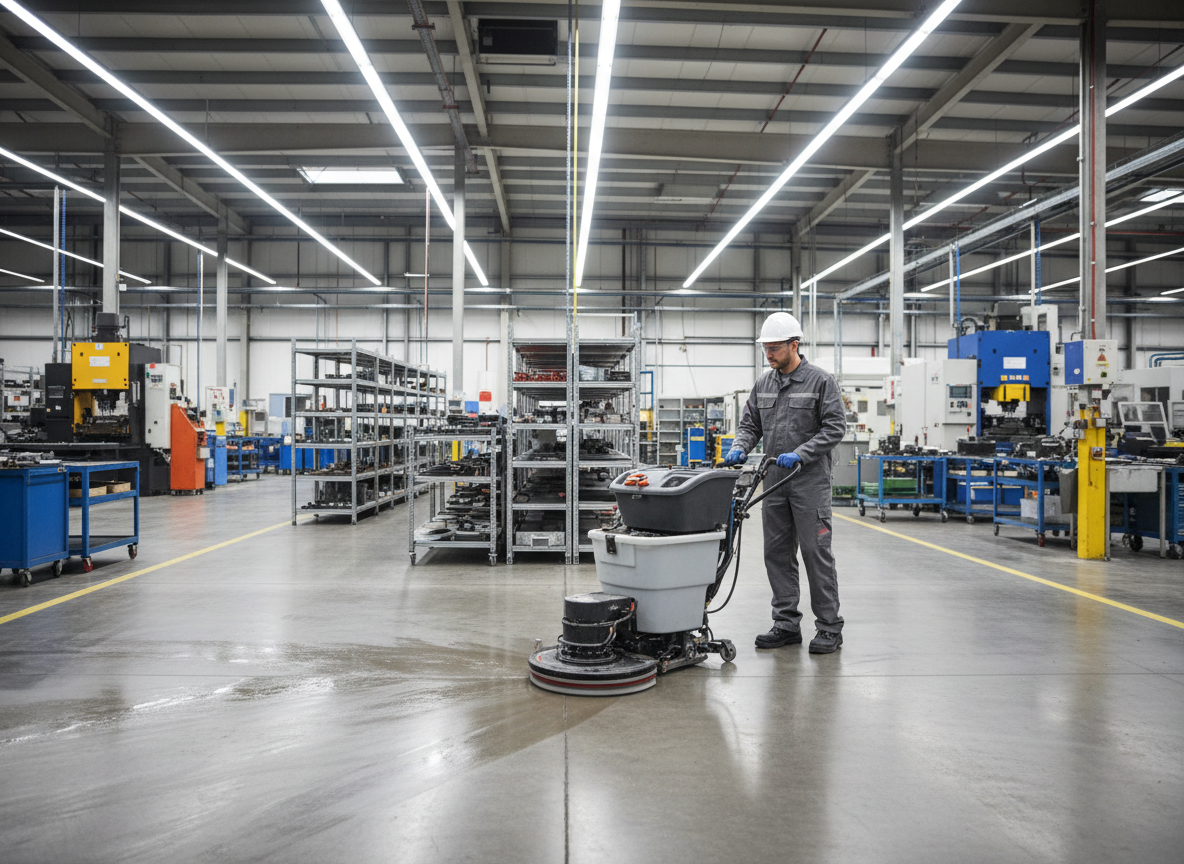
“Industrial cleaning” is a category rather than a single service. On South Yorkshire sites it usually means some combination of the following.
- Hard floor work. Machine scrubbing, degreasing and burnishing of concrete, resin and coated floors, including aisle and racking-perimeter work.
- High-level cleaning. Steelwork, ductwork, cladding, roof lights, pipe runs and the tops of racking, where dust accumulates out of sight.
- Plant and machinery surrounds. Degreasing floors and structures around production equipment, usually without touching the machine itself.
- Welfare and office areas. Canteens, changing rooms and washrooms attached to an industrial building, which are often the areas an auditor looks at first.
- Post-project and dilapidation cleans. After a refit, a line move, or at the end of a lease.
- External areas. Yards, loading bays, bin areas and service roads, typically pressure washed.
Where that work sits on a warehouse site specifically, we have broken it down further in our guide to what warehouse cleaning covers.
Check One: COSHH and the Chemicals Coming Onto Your Site
Industrial cleaning uses degreasers, acids, alkaline strippers and solvents. These are not household products, and they are regulated.
The Health and Safety Executive sets out that the COSHH Regulations 2002 require employers to assess the risks arising from hazardous substances, prevent or control exposure, and give staff information, instruction and training on the precautions taken. HSE is also explicit that the assessment has to cover the risks from storing, handling and disposing of those substances — not only the moment they are used.
That last point is the one worth pressing a contractor on. A drum of floor stripper is a hazard while it sits in your loading bay overnight, and the rinse water is a hazard when it goes down a drain.
What to ask for
- COSHH assessments for the specific products being brought on site — not a generic folder.
- Safety data sheets for each product, available on site during the work.
- Where chemicals will be stored while the job runs, and for how long.
- What happens to rinse water and residues, particularly on a site with interceptors or trade effluent consent.
- Confirmation that the operatives using the products have been trained on them.
Key point: If a contractor cannot produce a COSHH assessment for the product they are about to use in your building, that is not a paperwork gap. It means the assessment has not been done.

Check Two: Working at Height
High-level cleaning is where industrial jobs most often go wrong, because the work is intermittent and the temptation to improvise access is high. Racking uprights are not ladders, and a forklift is not a work platform.
HSE publishes dedicated guidance on planning and carrying out work at height safely, including the law, the safe use of ladders and stepladders, and a step-by-step planning guide. Any contractor quoting for cladding, ductwork or high-level dusting should be able to say which of those methods they intend to use and why.
What to ask for
- A written method statement for the high-level element specifically, naming the access equipment.
- Operator cards for any powered access being used, and evidence the equipment is inspected.
- Rescue arrangements if anyone will be working from a harness.
- Exclusion zones and how your own staff will be kept out of them.
Check Three: Waste, and the Duty That Stays With You
This is the check almost nobody makes, and the one with a direct financial consequence for the site owner.
If your cleaning contractor takes waste away — sludge from a floor scrub, swept debris, redundant stock, drums — they are transporting waste. GOV.UK is unambiguous that a business that transports waste must register with the Environment Agency as a waste carrier, and that an unlimited fine is possible for failing to register. Registered organisations appear on a public register you can search yourself.
So do that. It takes a minute, it is free, and it is the difference between a contractor who says they are registered and a contractor who is.
What to ask for
- The contractor’s waste carrier registration number — it begins with “CB” — and check it on the public register.
- Whether their registration is upper or lower tier; upper tier registrations require renewal every three years, so confirm the current one has not lapsed.
- Waste transfer documentation for anything removed from your site.
- Where the waste is going, and whether any of it is classed as hazardous.
Being straight about this: not every cleaning contractor is a waste carrier, and there is nothing wrong with one that is not — provided they say so and you arrange removal separately. The problem is only ever the contractor who is vague about it.
Check Four: Working Around Live Production
An industrial clean that stops your line costs more than the clean. The scheduling conversation should therefore happen before the pricing conversation, not after.
In practice, most Sheffield industrial sites fall into one of three patterns: a full shutdown window such as Christmas or the annual maintenance shut; a rolling area-by-area approach where one bay is isolated at a time; or night and weekend work while the building is empty. Each has a different cost profile, and each demands a different plan.
Whichever pattern fits, agree the practical details in writing: isolation of any equipment, whether drying time takes a floor out of use, permit-to-work requirements, site induction, sign-in, PPE standards, and who holds the keys. We go through the site-preparation side of this in more depth in our guide to preparing a factory site before a clean, and the scheduling side in our notes on working around a production shutdown.
The Pre-Start Document Checklist
Print this, or paste it into your enquiry email. A competent contractor will have all of it ready and will not be irritated by being asked.
| Document | Why it matters | Check |
|---|---|---|
| Risk assessment and method statement | Shows the job has been planned for your building, not a generic one | Names your site and the actual tasks |
| COSHH assessments and safety data sheets | Legal requirement for the substances used | Product-specific, dated, on site during work |
| Public liability insurance | Covers damage to your premises and plant | Current certificate; limit suits your site value |
| Employers’ liability insurance | Covers the contractor’s own staff | Current certificate |
| Waste carrier registration | Required to transport waste from your site | “CB” number verified on the public register |
| Work at height method statement | The highest-consequence part of most industrial cleans | Access equipment named; operator cards held |
| Training records | Evidence operatives can use the equipment and chemicals | Covers the people actually attending |
| Named site contact | Someone to call when something changes at 6am | Direct number, not a switchboard |
Getting an Accurate Industrial Cleaning Quote
Industrial jobs are difficult to price remotely, and any quote given without a site visit is a guess. When we look at a site we are measuring floor area and surface type, judging contamination levels, checking access heights and routes, and working out what can realistically be achieved in the window available.
Tell a prospective contractor the awkward things early — the mezzanine with no safe access, the resin floor that cannot take an aggressive stripper, the bay that cannot be emptied. Those constraints shape the method. Discovering them on the night turns a fixed price into a variation.
We carry out factory and warehouse cleaning across South Yorkshire, and it forms part of the wider commercial cleaning service we run in Sheffield for businesses that need one contractor across offices, welfare areas and the production floor.
FAQ: Industrial Cleaning in Sheffield
What is industrial cleaning?
Industrial cleaning is heavy-duty cleaning of working industrial premises — factories, warehouses, distribution centres and workshops — using specialist equipment and stronger chemicals than general cleaning. It typically covers hard floors, high-level surfaces, plant surrounds and external yards, and is planned around production rather than around office hours.
What is the difference between industrial cleaning and commercial cleaning?
Commercial cleaning generally means the routine upkeep of business premises such as offices, shops and washrooms. Industrial cleaning deals with the heavier contamination and harder environments of production and storage buildings, involves specialist plant, and carries higher safety and waste obligations. Many sites need both, often under one arrangement.
Does an industrial cleaning contractor need to be a registered waste carrier?
They do if they transport waste from your site. GOV.UK requires businesses that transport waste to register with the Environment Agency, with an unlimited fine possible for failing to do so. If your contractor is not registered, that is workable — but the waste removal needs arranging through someone who is.
Can industrial cleaning be done without stopping production?
Often, yes. Rolling area-by-area cleaning, night shifts and weekend work all allow a building to keep operating. Some tasks are the exception: aggressive floor treatments need drying time, and high-level work needs exclusion zones below. Those are usually scheduled into a shutdown or a quiet shift.
How often should an industrial site be professionally cleaned?
It depends far more on process than on building size. Sites generating dust, swarf or grease usually need a routine schedule plus periodic deep cleans; a dry storage warehouse may need far less frequent intervention but more high-level attention. The honest answer comes from a site visit, not a price list.
Talk to us about industrial cleaning in Sheffield
Tell us the site, the surfaces and the window you have available, and we will visit, plan the method properly and give you a fixed price — with the risk assessments and COSHH information supplied before we start. We cover Sheffield, Rotherham, Barnsley and Doncaster.
