
Industrial Floor Cleaning Methods: Scrubber-Dryer, Rotary or Jet Wash?


Industrial Floor Cleaning Methods: Scrubber-Dryer, Rotary or Jet Wash?
Most industrial floor cleaning methods work. The question is which one suits your floor, your contamination and your shift pattern — and which one leaves the floor safe to walk on ten minutes later.
Slips, trips and falls on the same level accounted for 30% of non-fatal injuries to employees reported under RIDDOR in 2024/25 — by a wide margin the largest single category. On an industrial site, the floor is the safety control, and how it is cleaned decides whether that control works.
That is the frame most buyers are missing. Industrial floor cleaning gets specified as a housekeeping line, judged on how the floor looks on the day, and reviewed once a year. The better question is narrower: what is on this floor, what is the floor made of, and which method removes one without damaging the other.
Which industrial floor cleaning method should you use? Use a ride-on or walk-behind scrubber-dryer for large sealed concrete, resin or vinyl floors with general soiling. Use a rotary machine for ground-in soiling, coating removal and small or obstructed areas. Use jet washing for external hardstanding and heavily greased bays. Match the method to the floor first, then to the area.
Choosing between industrial floor cleaning methods starts with the floor
Four surfaces cover most of what we meet on Sheffield industrial sites, and they behave very differently.
Power-floated concrete is hard, dense and usually sealed. It scrubs well, but an aggressive pad or the wrong alkaline product will dull the surface over time and make it harder to keep clean, not easier.
Resin and epoxy coatings look bulletproof and are not. They are chemically sensitive, and strong solvents or high-pH degreasers will haze or soften them. Manufacturer guidance on the coating beats any general cleaning advice.
Bare or porous concrete absorbs oil rather than holding it on the surface. Scrubbing lifts what is on top; the stain underneath needs dwell time with a degreaser or, on bad bays, repeated passes across several visits.
Vinyl and safety flooring in production areas and canteens has a deliberate slip-resistant texture. That texture holds soil in the grain, which is exactly why a flat mop achieves so little on it and a scrubber with the right brush achieves a lot.
Scrubber-dryer: the default for open, sealed floors
A scrubber-dryer applies solution, agitates with a brush or pad, and vacuums the water straight back up through a squeegee. That last part is the whole point — the floor is walkable within a minute or two rather than left to air dry.
On large open floors it is also the only method that covers the ground economically. A ride-on machine will clear a warehouse aisle system in a fraction of the time any manual method takes, and it does it consistently rather than well at the start and badly at the end of a shift.
Where it struggles is edges, corners, under racking and around fixed plant. A scrubber-dryer run without any edge work leaves a visible dirty border, and that border is usually what a visitor notices first.
Rotary machines: for ground-in soiling and coatings
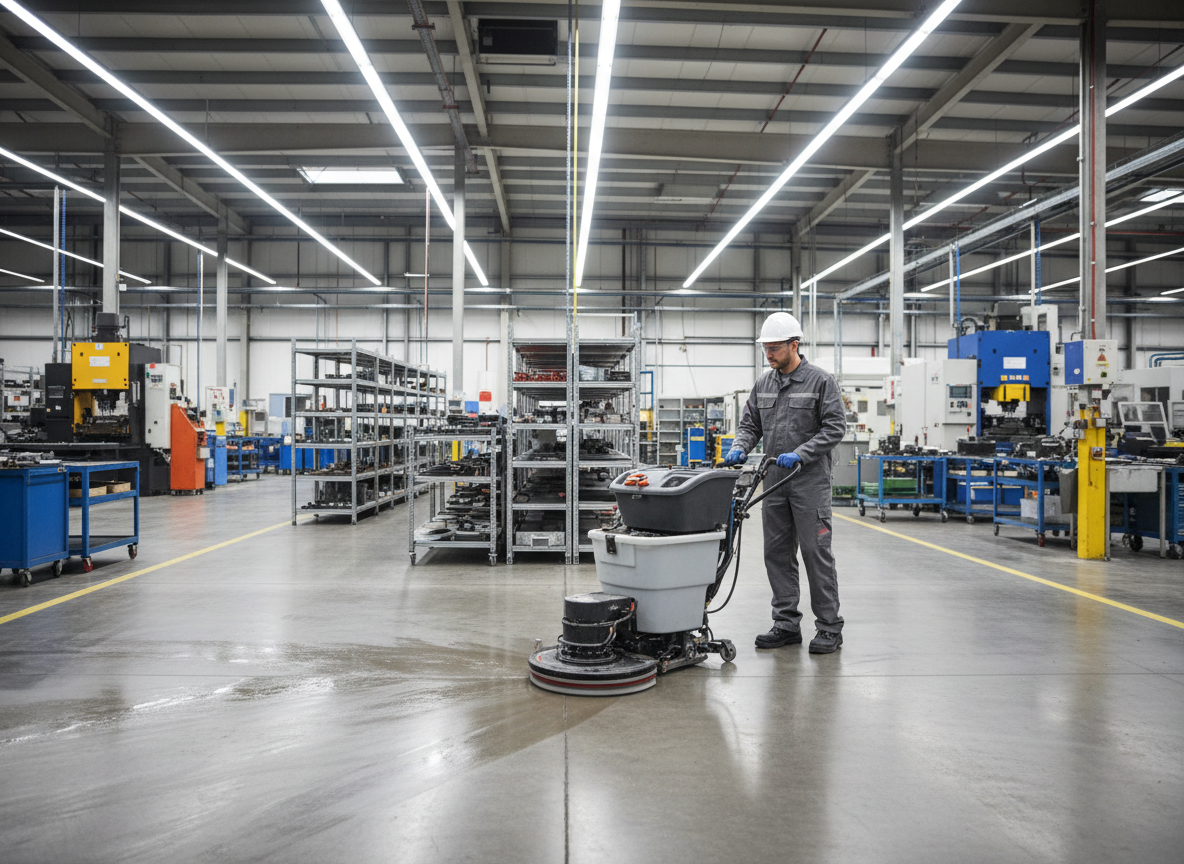
A rotary or single-disc machine turns slower and puts far more pressure through a smaller footprint. That makes it the tool for soiling that has been walked into a floor for years, for stripping old seal or polish before recoating, and for areas too tight or too obstructed for a ride-on.
It is also the honest answer when a floor has simply been under-cleaned for a long time. A scrubber-dryer maintains a floor. A rotary pass, followed by wet pick-up, is what brings one back before maintenance cleaning has anything to maintain.
The trade-off is speed and water management. Rotary work leaves standing solution that must be picked up separately, so it needs planning into a shift where nobody is walking through.
Jet washing: hardstanding, bays and grease
Pressure washing belongs outside, or inside on floors built to take it with drainage to match. Loading bays, yards, bin areas and external service routes are where it earns its place, along with heavily greased internal bays where a scrubber simply smears the contamination around.
Indoors, the risk is water going where it should not — into racking bases, under machine plinths, or through a doorway onto a floor with no fall. If there is no drain, there needs to be a wet vacuum plan before the lance comes out.
Where exterior hardstanding is the main issue rather than the production floor, that is a different visit with different kit — our commercial pressure washing service covers that side.
The method that causes accidents is the one that leaves the floor wet
HSE guidance puts it plainly: even using a well-wrung mop will leave a thin film of water, sufficient enough to create a slip risk on a smooth floor. Mopping a smooth industrial floor during a working shift is not a cleaning decision, it is a risk decision.
The same guidance is equally direct about method selection — make sure that your cleaning method is effective for the type of floor that you have, and use a dry mop or squeegee to cut drying time where a floor has been left wet.
This is the practical argument for machine cleaning on industrial sites, and it is stronger than the appearance argument. A scrubber-dryer removes the water it puts down. A mop and bucket moves it around and then leaves it.
Signs and cones do not solve it either. They warn; they do not prevent access. Cleaning in sections so there is always a dry route, or cleaning when the area is genuinely empty, is what actually removes the risk.
Matching frequency to traffic, not to the calendar
Frequency arguments usually come from the wrong end. The useful measure is how quickly contamination returns, which varies enormously inside one building.
- Goods-in and loading areas pick up water, mud and tyre marks from outside constantly, and usually need daily attention.
- Main aisles and pedestrian routes are the slip-risk routes and justify frequent machine passes even when they do not look dirty.
- Production bays depend entirely on the process — oil, coolant, swarf and dust all behave differently and some need spot response rather than a schedule.
- Racking bays and dead zones can run far longer between cleans, provided they are on a periodic programme rather than forgotten.
- Deep restorative work — stripping, re-sealing, heavy degreasing — is usually annual or biannual, and best timed to a shutdown.
If you want the scope side rather than the method side, our guide to what is included in warehouse floor cleaning sets out what a typical visit covers, and the hard floor cleaning guide covers the same questions for sealed and tiled floors in offices and public areas.
What we do on a Sheffield industrial site
We survey the floor before quoting: substrate, coating condition, drainage, contamination type and the traffic pattern through the building. That determines the method, not the other way round.
In practice most sites end up with a blend — scrubber-dryer maintenance on the open floor, periodic rotary work on the worst bays, manual edge detail, and jet washing outside. Selling a site one method for everything is how floors get damaged or under-cleaned.
Scheduling matters as much as method. Machine work on a live production floor is disruptive and slower, so most of what we do on factory and warehouse floors happens on a shutdown, a weekend or a night shift. Our guide to out-of-hours factory cleaning covers how that is usually arranged. The full service is on our factory and warehouse cleaning page.
Frequently asked questions
What is the best machine for cleaning a warehouse floor?
For a large sealed concrete or resin floor, a ride-on or walk-behind scrubber-dryer is normally the right answer, because it agitates and recovers the water in one pass and leaves the floor walkable almost immediately. Edges, corners and areas under racking still need manual or rotary work alongside it, or you get a clean floor with a dirty border.
Can you pressure wash a factory floor indoors?
Sometimes, but only where the floor and drainage were designed for it, or where there is a wet vacuum recovery plan. Without drainage the water finds racking bases, plinths and doorways. On most internal production floors a scrubber-dryer with a degreaser and adequate dwell time is the safer and tidier route.
How do you remove oil stains from concrete?
Surface oil comes off with a degreaser, dwell time and agitation. Oil that has soaked into porous or unsealed concrete is a different job — it usually needs repeated treatments across several visits, and on badly contaminated bays the realistic outcome is a substantial improvement rather than a like-new finish.
Is mopping enough for an industrial floor?
Rarely. Mopping moves contamination around, achieves little on textured safety flooring, and leaves a thin film of water that HSE identifies as a slip risk on smooth floors. It has a place for small spot cleaning and for areas machinery cannot reach, but it is not a floor-cleaning method for an industrial building.
How often should an industrial floor be deep cleaned?
Most sites run daily or weekly machine maintenance on traffic routes and goods-in areas, with a deeper restorative clean once or twice a year timed to a shutdown. The right interval is set by how fast contamination returns in each zone, so a single site frequently needs three or four different frequencies rather than one.
Get an industrial floor cleaning survey in Sheffield
No1 Dream Clean cleans factory, warehouse and workshop floors across Sheffield, Rotherham, Barnsley, Chesterfield and Dronfield. We survey the substrate and the contamination before quoting, recommend the method that suits your floor rather than the kit on the van, and work shutdowns, weekends and nights where production needs it.
Sheffield & South Yorkshire. Domestic & commercial. Big jobs. No stress.
Reviewed and signed off by No1 Dream Clean. We clean industrial floors on production and distribution sites across South Yorkshire, and we survey the floor before recommending a method rather than after.
Published 17 September 2026. Last updated 17 September 2026.
